
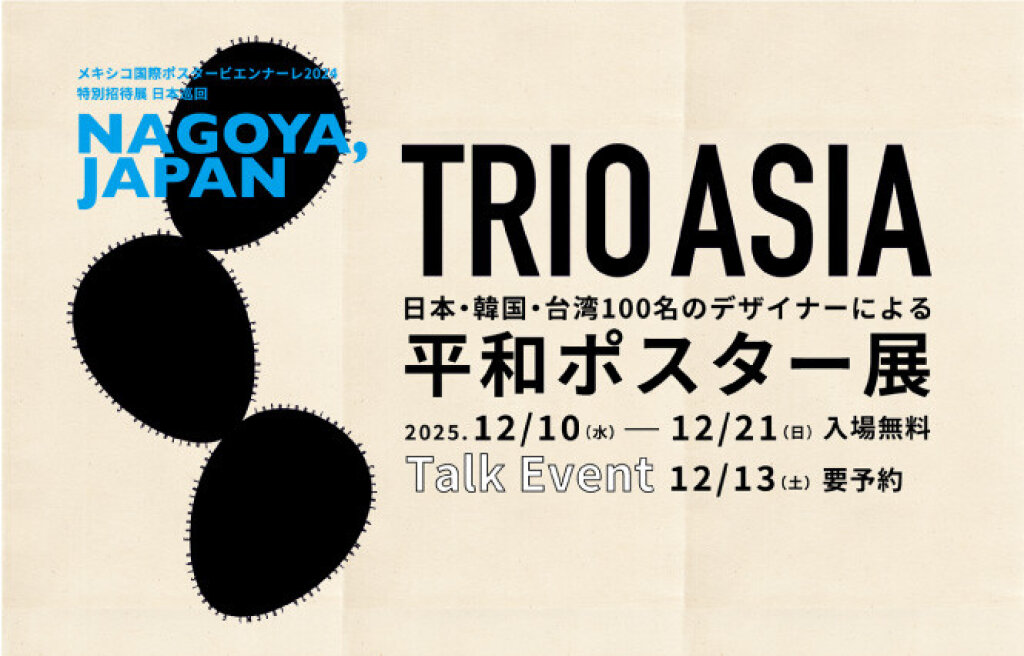
From 10-21 December 2025, the International Design Center in Nagoya (Design Gallery, NADYA PARK) hosts the latest edition of TRIO ASIA a traveling exhibition presenting 100 peace-themed posters created by designers from Japan, Korea, and Taiwan.
Amid a world facing growing uncertainty, the exhibition asks a timely and universal question:
How can designers communicate “peace” across languages, cultures, and borders?
A traveling initiative for shared visual dialogue
TRIO ASIA began as a Special Invitation Exhibition at the Bienal Internacional del Cartel en México (BICM)before travelling on to Taipei and Seoul, and now arrives in Nagoya. Each city adds new voices, new exchanges, and new reflections on the designer’s responsibility in shaping how societies see and understand peace.
GRANSHAN at TRIO ASIA
GRANSHAN is represented in Nagoya by President Boris Kochan and Advisory Board member Chang Sik Kim, who join both the exhibition and its surrounding conversations. Before the official opening, they met with many of the participating designers for an informal gathering, continuing the spirit of shared learning and cross-cultural dialogue that TRIO ASIA embodies.
Talk Event: Reporting, Reflecting, and Rethinking the Designer’s Role
A free public talk program accompanies the exhibition, connecting its touring history with a broader discussion on the social responsibilities of poster design
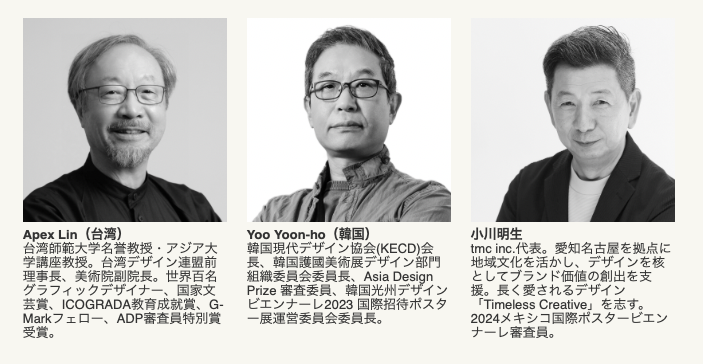
Talk 1: Reporting on the Mexico / Taiwan / Korea exhibitions
Speakers: Apex Lin (Taiwan), Yoo Yoon-ho (Korea / KECD), Akio Ogawa (Japan)
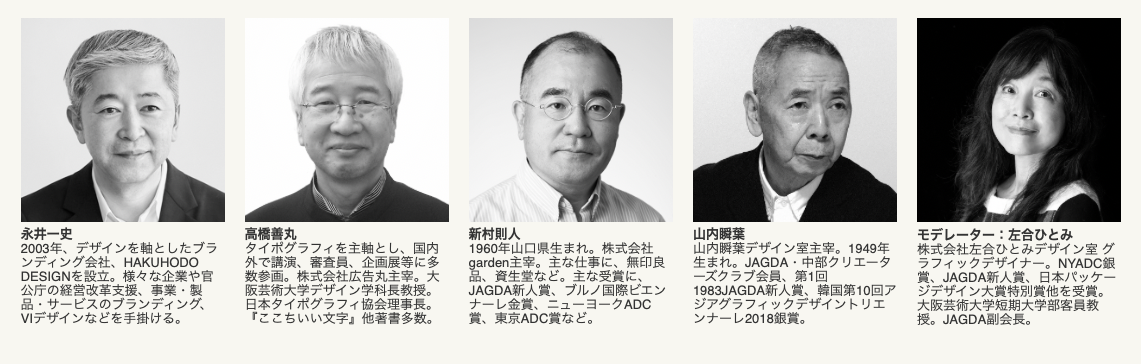
Talk 2: The meaning of peace posters & what designers are asked to do today
Speakers: Kazufumi Nagai, Yoshimaru Takahashi, Norito Shinmura, Shunyo Yamauchi
Moderator: Hitomi Sago
Together, the talks examine not only the posters themselves but the broader responsibilities of visual creators working in an era of rapid change.
Notable participants
The exhibition brings together prominent figures in contemporary Asian graphic design, including Katsumi Asaba, Kenya Hara, Taku Satoh, Kazumasa Nagai, and Shigeo Okamoto, whose work is part of MoMA’s permanent collection.
Our warmest appreciation goes to Isuzu Kariya (Hashimakita Senior High School), whose on-site coordination and translation support made the Nagoya program both smooth and welcoming.